| Byer India
|
|
| Landinformasjon |
landskode: IN
kontinentet: Asia
hovedstad: New Delhi
språk: Hindi, Engelsk, andre språk
EU-medlemskap: nei
NATO-medlemskap: nei
GSM: 900/1800
GPS: 20 00 N, 77 00 E
elektrisitet: 230V/50Hz
valuta:
Indisk rupi: INR
1INR = 0.022 USD
1INR = 0.017 EUR
Telefonkode:
+91-11
|
Travel råd og advarsler India
| Tourism |
Tourism in India is the largest service industry, with a contribution of 6. 23% to the national GDP and 8. 78% of the total employment in India. India witnesses more than 17. 9 million annual foreign tourist arrivals and 740 million domestic tourism visits. The tourism industry in India generated about 100 US$ billion in 2008 and that is expected to increase to US$275. 5 billion by 2018 at a 9. 4% annual growth rate. [1] In the year 2010, 17. 9 million foreign tourists visited India. Majority of foreign tourists come from USA and UK. Maharashtra, Tamil Nadu, Delhi, Uttar Pradesh and Rajasthan are the top 5 states to receive inbound tourists. [2] Domestic tourism in the same year was massive at 740 million. Andhra Pradesh, Uttar Pradesh, Tamil Nadu and Maharashtra received the big share of these visitors. [3][4] Ministry of Tourism is the nodal agency to formulate national policies and programmes for the development and promotion of tourism. In the process, the Ministry consults and collaborates with other stakeholders in the sector including various Central Ministries/agencies, the State Governments/ union Territories and the representatives of the private sector. |
| Culture |
India's languages, religions, dance, music, architecture, food and customs differ from place to place within the country, but nevertheless possess a commonality. India is the only country in the world to have so many religions and beliefs. The culture of India is an amalgamation of these diverse sub-cultures spread all over the Indian subcontinent and traditions that are several millennia old. [1]
Regarded by many historians as the "oldest living civilization of Earth", the Indian tradition dates back to 8000 BC[2] and has a continuous recorded history since the time of the Vedas, believed variously to be 3, 000 to over 5, 500 years ago. [3] Several elements of India's diverse culture — such as Indian religions, yoga and Indian cuisine — have had a profound impact across the world. |
| Cuisine |
|
| Climate |
Analyzed according to the Köppen system, the climate of India resolves into six major climatic subtypes; these give rise to desert in the west, alpine tundra and glaciers in the north, humid tropical regions supporting rain forests in the southwest, and Island territories flanking the Indian subcontinent. Regions have starkly different—yet tightly clustered—micro climates. The nation is largely subject to four seasons: winter (January and February), summer (March to May), a monsoon (rainy) season (June to September), and a post-monsoon period (October to December). |
| Language |
The languages of India belong to several language families, the major ones being the Indo-European languages—Indo-Aryan (spoken by 72% of Indians) and the Dravidian languages (spoken by 25% of Indians). [1] Other languages spoken in India belong to the Austro-Asiatic, Tibeto-Burman, and a few minor language families and isolates. |
| Shopping |
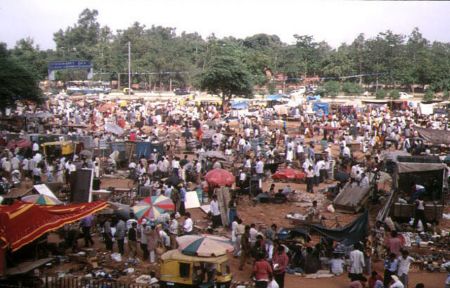
India is a shopper's paradise. You'll find everything from clothes to ceramics, and metal work to musical instruments. The only problem is how to get all your purchases back home! Read on to discover what to buy and where to shop 'til you drop. |
| Costs |
If you stay in cheap hotels, always travel 2nd class on trains and learn to subsist on dhal and rice, you could see India on just US$10 a day. If you prefer a few more creature comforts, like a simple private room with a bathroom, a varied diet, and occasional 1st class rail travel on long journeys, count on around US$20-25 a day. Staying in mid-range hotels, eating in decent restaurants, and occasionally hiring a car and driver will cost around US$30-35 a day. If you don't want to trespass beyond converted maharaja's palaces, and five-star international hotels, budget as if you were travelling comfortably in the West. |
| Currency |
The Indian Rupee is the original official currency of India. The English translation of "Rupee" is "silver, " and the name exists because it was previously a silver coin. This very fact had severe consequences in the 19th century, when the strongest economies in the world were on the gold standard. The discovery of vast quantities of silver in the U. S. and various European colonies resulted in a decline in the relative value of silver to gold. |
|